
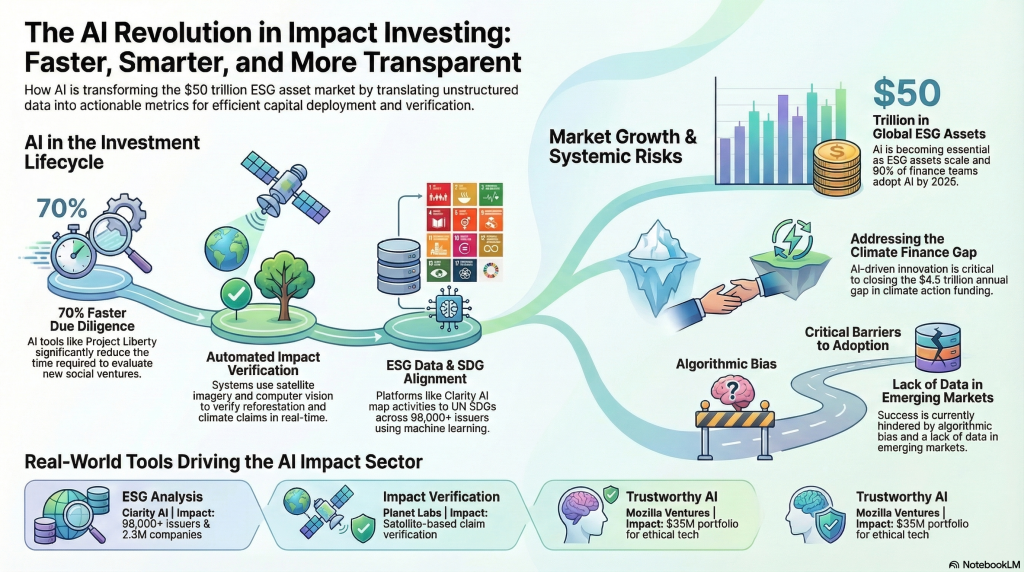
AI for social impact is no longer a futuristic concept — it is actively reshaping how investors find, evaluate, and fund ventures that generate measurable social and environmental returns. From automated ESG screening to predictive analytics for underserved communities, artificial intelligence is giving impact investors the tools they need to deploy capital faster, smarter, and more transparently than ever before.
In this guide, we explore how AI is transforming impact investing across every stage of the investment lifecycle — and why this convergence matters for anyone who cares about building a better world through finance.
Why AI and Impact Investing Are a Natural Fit
Impact investing sits at the intersection of financial returns and positive social outcomes. But historically, measuring “impact” has been one of the sector’s biggest challenges. How do you quantify improvements in healthcare access, educational outcomes, or carbon reduction — and do it consistently across hundreds of portfolio companies?
This is where AI enters the picture. Machine learning algorithms can process vast amounts of unstructured data — satellite imagery, news feeds, social media sentiment, government reports — and translate them into actionable metrics. The social impact of AI in this context is not abstract; it is concrete and measurable.
According to recent industry data, global ESG assets are expected to exceed $50 trillion, accounting for over a third of all assets under management. With 90% of finance teams planning to deploy at least one AI-enabled solution by 2026, the technology is rapidly becoming essential for sustainable and social impact investing.
How AI Is Used in Impact Investing: Key Applications
AI is not a single tool — it is a collection of capabilities that can be applied across the entire investment process. Here are the most impactful use cases.
1. AI-Powered Deal Sourcing
Finding the right impact-driven startups and social enterprises has traditionally relied on personal networks and manual research. AI changes this by scanning thousands of data sources simultaneously — startup databases, patent filings, academic publications, and news — to surface high-potential opportunities that align with specific impact themes.
Platforms like Crunchbase Pro and PitchBook now integrate AI-driven filters that let investors screen for social and environmental criteria alongside financial metrics. This makes ai investing more efficient and reduces the risk of missing promising ventures in underrepresented regions.
2. ESG Data Analysis and Scoring
ESG (Environmental, Social, and Governance) data is notoriously fragmented. Companies report in different formats, using different frameworks, and with varying levels of transparency. AI excels at normalizing this data.
Leading platforms in this space include:
- Clarity AI — covers 98,000+ issuers, 2.3 million private companies, and 450,000+ funds, using machine learning for full traceability back to source data
- MSCI ESG Research — uses natural language processing to scan thousands of media sources daily for ESG-relevant events
- Sustainalytics — offers institutional-grade data with proprietary AI-powered incident detection
These tools help investors move beyond self-reported company data and get a more objective picture of real-world ai social impact performance.
3. Impact Measurement and Verification
Perhaps the most transformative application is in impact measurement itself. Traditional approaches rely on surveys, site visits, and self-reported metrics — all of which are slow, expensive, and prone to bias.
AI-powered systems can now:
- Analyze satellite imagery to verify reforestation or clean energy projects
- Use natural language processing to scan beneficiary feedback at scale
- Cross-reference multiple data sources to detect greenwashing or impact-washing
- Generate real-time impact dashboards tied to the UN Sustainable Development Goals (SDGs)
This level of verification was simply impossible five years ago. It represents a fundamental shift in how the social impact of AI is applied to accountability in finance.
4. Risk Assessment and Predictive Analytics
Impact investments often target emerging markets, early-stage enterprises, or sectors (like clean energy or affordable housing) with complex risk profiles. AI-driven predictive models help investors assess:
- Credit risk for microfinance and social lending portfolios
- Political and regulatory risk using geopolitical NLP models
- Climate risk exposure across physical assets and supply chains
- Market adoption curves for new social technologies
By processing more variables than any human analyst could, AI reduces blind spots and helps impact investors make better-informed decisions. The ai impact on economy is particularly visible here, as smarter capital allocation drives growth in underserved sectors.
5. Portfolio Monitoring and Reporting
Once investments are made, AI helps track ongoing performance against both financial and impact KPIs. Automated reporting tools pull data from portfolio companies, benchmark it against sector norms, and flag anomalies — all in real time.
This is critical for institutional investors who need to report to stakeholders, comply with regulations like the EU’s Sustainable Finance Disclosure Regulation (SFDR), and demonstrate that their capital is genuinely driving positive change.
Real-World Examples of AI for Social Good in Investing
The convergence of AI and impact investing is not theoretical. Here are concrete examples of ai for social good already in action.
Project Liberty’s AI Due Diligence Tool
In late 2025, Project Liberty partnered with ReframeVenture and ImpactVC to launch an AI-powered due diligence tool specifically designed for venture capitalists evaluating social impact startups. The tool automates background checks, impact claim verification, and financial modeling — cutting due diligence time by up to 70%.
Mozilla Ventures’ Trustworthy AI Portfolio
Mozilla Ventures built a $35 million portfolio focused exclusively on trustworthy AI companies. Their investment thesis centers on backing startups that develop AI responsibly — with built-in safeguards for privacy, fairness, and transparency. This is ai investing with a conscience.
Clarity AI’s SDG Alignment Engine
Clarity AI’s platform uses machine learning to map company activities to the 17 UN Sustainable Development Goals. Institutional investors use it to build portfolios that are not just financially sound but also aligned with specific global impact targets — from clean water to gender equality.
Satellite-Based Impact Verification
Organizations like Planet Labs and Orbital Insight use AI to analyze satellite imagery for impact verification. Investors in reforestation, sustainable agriculture, or renewable energy projects can now independently verify claims using visual data processed by computer vision algorithms — no site visit required.
The AI Impact on Economy: Why This Matters Beyond Finance
The ai impact on economy extends far beyond Wall Street. When AI helps direct capital toward high-impact ventures in emerging markets, the ripple effects are enormous:
- Job creation — AI-identified investments in clean energy, healthcare, and education generate employment in communities that need it most
- Innovation acceleration — startups that solve real social problems get funded faster, bringing solutions to market sooner
- Financial inclusion — AI-driven credit scoring enables lending to populations that traditional banks overlook
- Climate action — better data leads to better climate investments, helping close the estimated $4.5 trillion annual gap in climate finance
However, it is important to acknowledge the current funding disparity. While global AI venture capital investments exceeded $290 billion between 2019 and 2024, less than 1% of this funding went to initiatives aimed at social impact. Closing this gap is one of the most important challenges for the impact investing community.
Challenges and Limitations of AI in Impact Investing
AI is powerful, but it is not a silver bullet. Impact investors should be aware of several challenges:
Data Quality and Availability
AI models are only as good as their training data. In many emerging markets, reliable social and environmental data is scarce. This can lead to biased models that favor well-documented regions and overlook the communities that need investment most.
Algorithmic Bias
If historical data reflects systemic inequities — which it often does — AI systems can perpetuate those biases. Impact investors must demand transparency in the algorithms they use and actively test for fairness across demographics and geographies.
The Skills Gap
Only 7% of publicly available impact-focused AI initiatives center around AI education or skills development. Adoption rates among social innovators lag behind the 78% of global companies either using or exploring AI. Bridging this skills gap is essential for ai for social impact to reach its full potential.
Cost of Entry
Enterprise-grade AI tools for ESG analysis and impact measurement can be expensive. Smaller impact funds and community-based investors may struggle to access the same technology as large institutional players, creating a new digital divide within the impact investing ecosystem.
How to Get Started with AI-Driven Impact Investing
Whether you are an individual investor, a fund manager, or a social entrepreneur, here are practical steps to leverage AI for impact:
- Define your impact thesis clearly — AI works best when you know what outcomes you are targeting (e.g., climate mitigation, gender equity, healthcare access)
- Start with accessible tools — platforms like Clarity AI, MSCI ESG Manager, and even ChatGPT-based research workflows can provide immediate value without massive investment
- Prioritize data transparency — choose AI tools that show their sources and methodology, not just outputs
- Combine AI with human judgment — the best impact investing decisions blend quantitative AI insights with qualitative understanding of local contexts
- Advocate for open data — support initiatives that make social and environmental data more accessible, especially in emerging markets
Frequently Asked Questions
What is social impact investing?
Social impact investing is an investment strategy that aims to generate measurable social or environmental benefits alongside financial returns. Unlike traditional philanthropy, impact investors expect their capital back — plus a return. Common sectors include affordable housing, clean energy, healthcare, education, and financial inclusion. To learn more, read our complete guide on what is impact investing.
How does AI help impact investing?
AI helps impact investing in several ways: it automates deal sourcing to find high-potential social enterprises, analyzes ESG data at scale, measures and verifies real-world impact using satellite imagery and NLP, assesses risk in complex emerging markets, and generates real-time portfolio reports. In short, AI makes impact investing faster, more transparent, and more data-driven.
Can AI really measure social impact accurately?
AI has made significant advances in impact measurement, but it is not perfect. Machine learning can process data from diverse sources — surveys, satellite images, financial records, social media — to build a more complete picture of impact than traditional methods. However, AI should complement, not replace, on-the-ground expertise and community feedback.
What are the best AI tools for impact investors?
Some of the leading AI-powered platforms for impact investors include Clarity AI (broad ESG and SDG alignment), MSCI ESG Research (institutional-grade scoring), Sustainalytics (incident detection), and specialized tools like Project Liberty’s AI due diligence platform. The best choice depends on your portfolio size, impact focus, and budget.
Is AI for social impact only for large investors?
No. While enterprise-grade platforms can be expensive, many AI tools are becoming more accessible. Free or low-cost options include open-source NLP libraries, government open data portals, and AI-powered research assistants. The key is to start small and scale as your needs grow.
The Enterprise Incubator Foundation (EIF) supports innovation, technology, and entrepreneurship in Armenia. Through programs that connect startups with global markets, EIF helps build an ecosystem where technology serves both economic growth and social good. From AI education initiatives to startup acceleration, EIF is committed to ensuring that the benefits of artificial intelligence reach every community.