
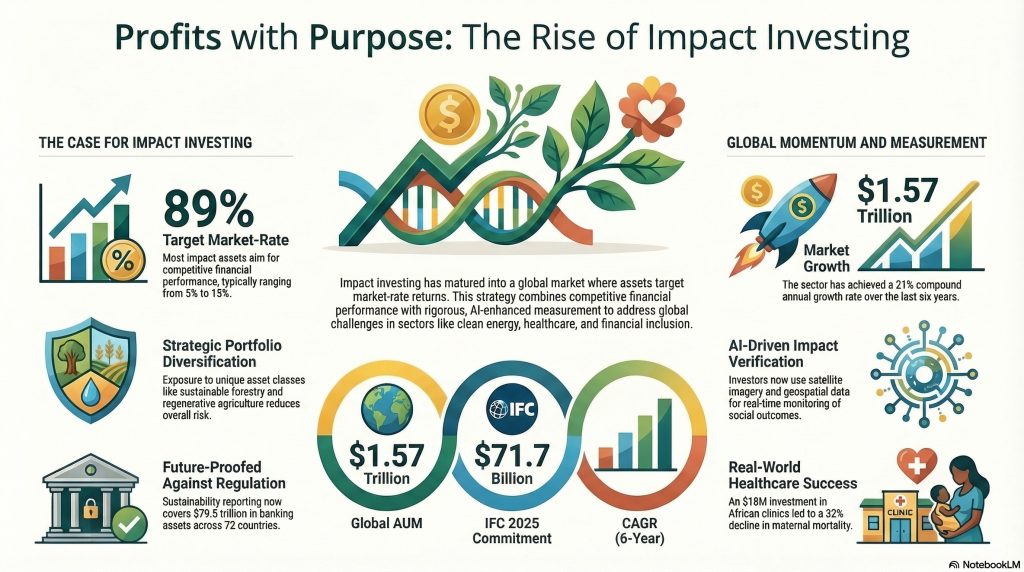
The benefits of impact investing are reshaping how capital flows around the world. Once considered a niche corner of philanthropy, impact investing has exploded into a $1.57 trillion global market, according to the Global Impact Investing Network (GIIN). More institutional investors, family offices, and even individual portfolios are now allocating funds toward investments that generate measurable social and environmental outcomes alongside financial returns.
But why is this shift happening now? And what makes impact investing so compelling compared to traditional approaches? In this guide, we break down the key benefits, explore real-world case studies, and explain how technology — including AI for social impact — is making the entire field more transparent and accountable.
If you are new to the concept, start with our comprehensive overview: What Is Impact Investing? Definition, Types & How It Works.
What Is Impact Investing? A Quick Refresher
What is impact investing in simple terms? It is the practice of deploying capital into companies, organizations, and funds with the explicit intention of generating a positive, measurable social or environmental impact alongside a financial return. Unlike pure philanthropy, impact investors expect their money back — often with competitive returns.
The field spans a wide range of asset classes, from private equity and venture capital to green bonds, real estate, and microfinance. What unites all impact investments is a shared commitment to intentionality, measurement, and accountability.
The Top Benefits of Impact Investing
So why are more investors choosing social impact investing over purely profit-driven strategies? Here are the most compelling advantages.
1. Competitive Financial Returns
The myth that impact investing means sacrificing returns has been thoroughly debunked. According to the GIIN’s 2025 Impact Investor Survey, 89% of impact assets under management target market-rate returns, and the majority of respondents report meeting or exceeding their financial expectations. Depending on the asset class, returns typically range from 5% to 15%.
This “blended value proposition” — the idea that economic, social, and environmental value are inherently interconnected — is no longer theoretical. It is backed by trillions of dollars in real capital.
2. Portfolio Diversification
Impact investments provide access to asset classes and geographies that traditional portfolios often overlook. Sustainable forestry, regenerative agriculture, clean energy infrastructure, affordable housing, and community development finance all offer return profiles that behave differently from conventional equities and bonds. This diversification can reduce overall portfolio risk while opening doors to high-growth sectors.
3. Alignment with Values and Purpose
A growing number of investors — particularly millennials and Gen Z — want their money to reflect their values. Social finance allows individuals and institutions to support causes they care about (climate action, gender equity, healthcare access, education) without giving up financial performance. This alignment drives higher engagement and longer-term commitment to investment strategies.
4. Measurable Social and Environmental Outcomes
Unlike traditional CSR or vague “do good” pledges, impact investing demands rigorous measurement. Frameworks like the GIIN’s IRIS+ system and alignment with the UN Sustainable Development Goals (SDGs) give investors standardized metrics to track progress. You do not just hope your investment makes a difference — you can prove it.
5. Future-Proofing Against Regulatory and Market Shifts
Governments worldwide are tightening sustainability disclosure requirements. Mandatory sustainability reporting now covers $79.5 trillion in banking assets across 72 countries. Companies and portfolios aligned with ESG and impact criteria are better positioned to navigate this regulatory landscape, avoiding stranded assets and reputational risk.
6. Attracting Talent and Stakeholders
For institutions and corporations, a visible commitment to impact investing signals purpose-driven leadership. This attracts top talent, strengthens stakeholder relationships, and builds brand equity — all of which contribute to long-term financial resilience.
The Growing Market: Impact Investing by the Numbers
The scale of impact investing is no longer in question. Here are the numbers that define the current landscape:
- $1.57 trillion in assets under management globally, managed by over 3,900 organizations (GIIN, 2024)
- 21% compound annual growth rate over the past six years
- The market is projected to grow from $629 billion in 2025 to $748 billion in 2026 (19% CAGR), with forecasts reaching $1.54 trillion by 2030
- The IFC committed a record $71.7 billion in fiscal year 2025 — more than double its 2022 figure
- 429 organizations across 54 countries participated in the GIIN’s 2025 survey, the most comprehensive data set to date
These figures tell a clear story: social impact investing is not a trend. It is a structural shift in how global capital is allocated.
Real-World Case Studies: Impact Investments That Work
Numbers are powerful, but real-world examples bring the benefits of impact investing to life. Here are three cases that demonstrate both financial viability and measurable social outcomes.
Financial Inclusion in Southeast Asia
A $22 million Series B investment in a mobile lending platform serving informal workers in Southeast Asia reached 340,000 first-time credit users. With an average loan size of $180, borrowers were able to expand small businesses and improve household stability. The platform maintained a 94% repayment rate and projected an internal rate of return (IRR) of 18%.
Healthcare Delivery in Sub-Saharan Africa
An $18 million investment funded 35 primary care clinics across Sub-Saharan Africa, generating 285,000 patient visits annually. In the communities served, maternal mortality declined by 32%. The investment demonstrated that healthcare delivery in underserved markets can be both impactful and financially sustainable.
Sustainable Agriculture in Europe
The Amundi Ambition Agri-Agro strategy, backed by a $130 million commitment, is facilitating the transition of European agricultural and agri-food sectors toward sustainable models. By financing regenerative practices and responsible supply chains, the fund combines environmental stewardship with stable agricultural returns.
How AI Is Transforming Impact Measurement
One of the historic challenges in impact investing has been measurement. How do you reliably quantify social and environmental outcomes? This is where AI for social impact is making a breakthrough.
Real-Time Impact Verification
AI tools can now scrape and analyze unstructured data from local news sources, social media, satellite imagery, and government databases to build comprehensive, real-time pictures of how investments are performing on the ground. This eliminates the lag between deploying capital and understanding its effects.
Climate Risk Monitoring
For infrastructure and real estate impact investments, AI can analyze geospatial data to monitor physical climate risk in real time. Investors get a granular, continuously updated view of their exposure to climate adaptation needs — a capability that was impossible just a few years ago.
AI-Powered Due Diligence
In late 2025, Project Liberty, ReframeVenture, and ImpactVC launched an AI Due Diligence Tool specifically designed for venture capital impact assessments. Tools like these use AI for data analysis to streamline impact measurement and management (IMM), reducing costs and improving accuracy for fund managers.
As the Stanford Social Innovation Review notes, AI is an “exciting umbrella of technologies with potential to transform how investors think about impact measurement and management.” While challenges remain — AI models are only as good as their inputs — the trajectory is clear: technology is making impact investing more transparent, rigorous, and scalable.
Key Sectors Driving Social Impact Investing
Where is impact capital flowing? The GIIN’s data highlights several priority sectors where investors see the greatest opportunity to combine returns with meaningful outcomes:
- Inclusive Financial Services: Expanding access to banking, credit, and insurance for underserved populations
- Clean Energy: Funding renewable energy infrastructure, battery storage, and grid modernization
- Healthcare: Investing in digital health platforms, primary care delivery, and medical technology for emerging markets
- Affordable Housing: Developing quality, accessible housing in high-need urban and rural areas
- Education and Workforce Development: Supporting technology-enabled learning and skills training programs
- Sustainable Agriculture: Financing regenerative farming, responsible supply chains, and food security initiatives
Asia, Africa, and Latin America represent massive untapped opportunities, with governments in these regions increasingly embedding social finance strategies into national development plans.
How to Get Started with Impact Investing
Ready to explore the benefits of impact investing for yourself? Here is a practical roadmap based on your experience level.
For Beginning Investors
- Public market funds: Start with ESG-screened mutual funds or ETFs that incorporate impact criteria
- Community development notes: Organizations like Calvert Impact Capital offer fixed-income products starting at modest minimums
- Robo-advisors: Several platforms now offer impact-focused portfolio options with low entry barriers
For Experienced Investors
- Private equity and venture capital: Direct investments in social enterprises, clean technology startups, or impact-focused funds
- Green bonds: Fixed-income instruments that finance climate and environmental projects
- Real assets: Sustainable forestry, renewable energy infrastructure, and affordable housing developments
For Organizations in Emerging Markets
In Armenia and across the South Caucasus, organizations like the Enterprise Incubator Foundation (EIF) play a vital role in connecting innovative startups with impact-oriented capital. By nurturing technology ventures that address local and global challenges, EIF helps bridge the gap between entrepreneurial ambition and the growing pool of impact investment capital.
Frequently Asked Questions
What is impact investing?
Impact investing is the practice of investing in companies, organizations, or funds with the intention of generating measurable social or environmental benefits alongside a financial return. It differs from philanthropy because investors expect their capital back, often with competitive returns. The Global Impact Investing Network (GIIN) estimates the market at over $1.57 trillion in assets under management. For a deeper dive, read our full guide: What Is Impact Investing? Definition, Types & How It Works.
Why is investing important for social change?
Why is investing important when we already have philanthropy and government aid? Because the scale of global challenges — from climate change to healthcare access — far exceeds what donations and public budgets can address alone. The UN estimates that achieving the Sustainable Development Goals requires $5 to $7 trillion annually. Impact investing mobilizes private capital to fill this gap, creating sustainable funding flows that can operate at scale and generate returns that attract even more investment over time.
Is impact investing profitable?
Yes. The GIIN’s research shows that 89% of impact assets target market-rate returns, and the majority of impact investors report meeting or exceeding their financial benchmarks. Returns vary by asset class — typically 5% to 15% — but the evidence consistently shows that generating social and environmental impact does not require sacrificing financial performance.
How is impact measured in impact investing?
Impact is measured using standardized frameworks such as the GIIN’s IRIS+ metrics system, alignment with the UN Sustainable Development Goals, and increasingly through AI-powered analytics that provide real-time verification of social and environmental outcomes. Mandatory sustainability disclosures in 72 countries are also driving more rigorous and comparable reporting standards.
What is the role of AI in impact investing?
AI for social impact is transforming how investors measure and verify outcomes. AI tools analyze satellite imagery, social media data, and financial records to provide real-time insights into investment performance. New AI due diligence tools launched in 2025 are making impact assessment faster, cheaper, and more accurate for fund managers worldwide.
The Enterprise Incubator Foundation (EIF) supports technology-driven innovation and entrepreneurship across Armenia and the region. By fostering startups that combine commercial viability with social purpose, EIF contributes to an ecosystem where impact investing can thrive — connecting emerging market entrepreneurs with the capital, mentorship, and networks they need to scale solutions that matter.