
Millions of students use AI writing tools every day. And millions of educators are wondering the same question: can Turnitin detect AI? The short answer is yes — to a degree. But the reality is more nuanced than a simple yes or no. This guide explains exactly how Turnitin’s AI detection works, how accurate it is, what it flags, and what it means for students and teachers.
What Is Turnitin?
Turnitin is a plagiarism detection platform used by schools and universities around the world. When a student submits a paper, Turnitin compares it against a massive database of published work, websites, and previously submitted papers to look for copied text.
In recent years, Turnitin has expanded beyond plagiarism checking. In 2023, it launched an AI writing detection feature, designed to identify text that was likely written by AI tools like ChatGPT, Gemini, or Claude rather than by a human.
How Does Turnitin’s AI Checker Work?
Turnitin’s AI detector uses a type of machine learning called a language model classifier. In plain terms, it has been trained on large amounts of both human-written and AI-generated text. Over time, it has learned to recognize patterns that tend to appear in AI writing.
AI-generated text often has certain characteristics:
- Very consistent sentence structure and flow.
- Low variation in word choice and sentence length.
- Predictable transitions between ideas.
- A formal, neutral tone without strong personal voice.
Turnitin’s system scores each document with a percentage — for example, “82% of this text may have been AI-generated.” This score does not mean the student definitely used AI. It is a probability estimate, not a verdict.
How Accurate Is the Turnitin AI Detector?
Turnitin has published its own accuracy data. According to the company, its AI detection system has a false positive rate of less than 1% at the document level when the threshold is set to flag content with more than 20% AI-written text.
However, this figure comes with important caveats:
- Sentence-level accuracy is lower. Turnitin itself advises that individual sentence-level scores are less reliable than document-level scores.
- Non-native English speakers may be disproportionately flagged. Writing that is formulaic, simple, or lacks idiomatic phrasing can sometimes resemble AI-generated text — even when it was written by a human.
- AI models evolve rapidly. Newer AI tools may produce text that is harder to detect than what Turnitin was trained on.
In short: Turnitin’s AI checker is a useful indicator, but it is not infallible. Educators should treat AI detection scores as one data point — not as definitive proof.
How to Use the Turnitin AI Checker
The AI writing detection feature is available to institutions that have purchased Turnitin’s services. Here is how it works in practice:
For Instructors
- When you receive a student submission through Turnitin, open the submission in the document viewer.
- The AI writing report appears alongside the similarity (plagiarism) report. It highlights which portions of the text were flagged as potentially AI-generated.
- Highlighted segments are colour-coded based on confidence level.
- The overall AI score appears as a percentage at the top of the report.
- You can click on highlighted sections to see why they were flagged.
For Students
Some institutions allow students to view their own Turnitin reports before final submission. If your school has enabled this, you can check your AI score and revise your work before the deadline. However, many schools do not share AI detection results directly with students.
What Does Turnitin Actually Flag?
It is important to understand what the tool is and is not detecting:
- It flags text that statistically resembles AI output — not use of AI tools per se.
- It does not detect AI-assisted research or idea generation — only the final written text.
- It does not flag content that has been significantly paraphrased or rewritten after AI generation, though it may still catch partially reworked passages.
- It does not identify which specific AI tool was used.
As a result, a student who used AI to generate a draft and then thoroughly rewrote it in their own words may not be flagged at all. Conversely, a student who did not use AI but writes in a clear, simple, structured style may receive a lower-confidence flag.
Implications for Students
The rise of AI detection tools raises important questions for students. Here is what you need to know:
Know Your Institution’s Policy
Universities and schools have very different rules about AI use. Some prohibit it entirely. Others allow AI for research but not for writing. Some permit AI assistance with full disclosure. Before submitting any work, understand exactly what your institution allows.
AI Detection Is Not the Only Risk
Even if Turnitin does not flag your work, instructors who know you well can often tell when writing does not sound like you. A sudden shift in vocabulary, tone, or argumentation style raises flags independently of any software.
Use AI as a Tool, Not a Shortcut
AI can be a genuinely helpful study tool — for brainstorming, understanding complex topics, getting feedback on drafts, or structuring your ideas. Using it to bypass the learning process entirely is a different matter, and it carries both academic and ethical risks.
Implications for Educators
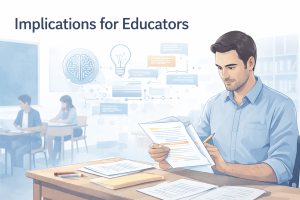
For teachers and professors, AI detection tools are a useful addition to the toolkit — but they should not be the only response to the challenge of AI-generated work.
Design Assignments That Are Harder to AI-Generate
In-class writing, oral components, personal reflections, case studies based on course-specific materials, and assignments that require students to reference classroom discussions are much harder to fake with AI.
Treat Detection Scores as Indicators, Not Evidence
A high Turnitin AI score should prompt a conversation with the student — not an automatic sanction. It is possible to receive a high score without having used AI, particularly for students writing in a second language or those with a naturally formal writing style.
Update Academic Integrity Policies
AI use policies need to be explicit, current, and communicated clearly to students at the start of every course. Vague policies create confusion and inconsistent enforcement.
The Bigger Picture: AI and Academic Integrity
Turnitin’s AI checker is one tool in an evolving landscape. As AI becomes more sophisticated, detection will become harder. As detection improves, AI tools will adapt in response. This is not a problem that technology alone will solve.
The more important conversation — for students, educators, and institutions — is about the purpose of education itself. What are assignments supposed to achieve? What skills are students meant to develop? How can AI be used in ways that enhance learning rather than replace it?
For more on how AI is changing education, read our post on AI in schools: the real pros and cons. And if you are curious about the broader debate on AI and the future of work, see our analysis of whether AI will replace humans.
The Enterprise Incubator Foundation (EIF) is committed to promoting thoughtful, responsible use of technology in education and business. We support digital literacy and help Armenia’s next generation navigate a rapidly changing technological landscape.