
Understanding the Social Impact of AI
Artificial intelligence is no longer a futuristic concept confined to research labs. It is embedded in the tools we use every day — from the algorithms that recommend what we watch to the systems that screen job applications and diagnose diseases. The social impact of AI is now one of the defining questions of our time: how is this technology reshaping communities, economies, and the fabric of daily life?
The answer is not simple. AI is simultaneously creating extraordinary opportunities and introducing serious risks. It is improving healthcare outcomes in some communities while deepening inequality in others. It is generating economic growth while displacing workers. It is making education more personalized while raising concerns about surveillance and privacy.
This guide examines the full picture — the benefits, the risks, and the practical steps that governments, businesses, and individuals can take to ensure that AI for social good is not just a slogan but a reality.
How AI Is Creating Positive Social Impact
AI for Social Good in Healthcare
Perhaps nowhere is the social impact of AI in healthcare more visible than in diagnostics. AI-powered systems can now analyze medical images — X-rays, MRIs, pathology slides — with accuracy that rivals or exceeds trained specialists. Google DeepMind’s AlphaFold, for example, predicted the 3D structure of nearly every known protein, a breakthrough that is accelerating drug discovery for diseases that disproportionately affect low-income populations.
Beyond diagnostics, AI is transforming healthcare access in underserved regions:
- Remote diagnostics: In rural parts of India and Sub-Saharan Africa, AI-powered mobile apps allow community health workers to screen for conditions like diabetic retinopathy and tuberculosis without specialist equipment.
- Drug discovery: AI models are reducing the time and cost of developing new treatments. Insilico Medicine used AI to identify a novel drug candidate for idiopathic pulmonary fibrosis in under 18 months — a process that traditionally takes 4-5 years.
- Mental health support: Conversational AI chatbots like Woebot and Wysa are providing cognitive behavioral therapy techniques to millions of users who lack access to traditional mental health services.
- Epidemic prediction: AI systems are analyzing global health data to predict disease outbreaks earlier, enabling faster public health responses.
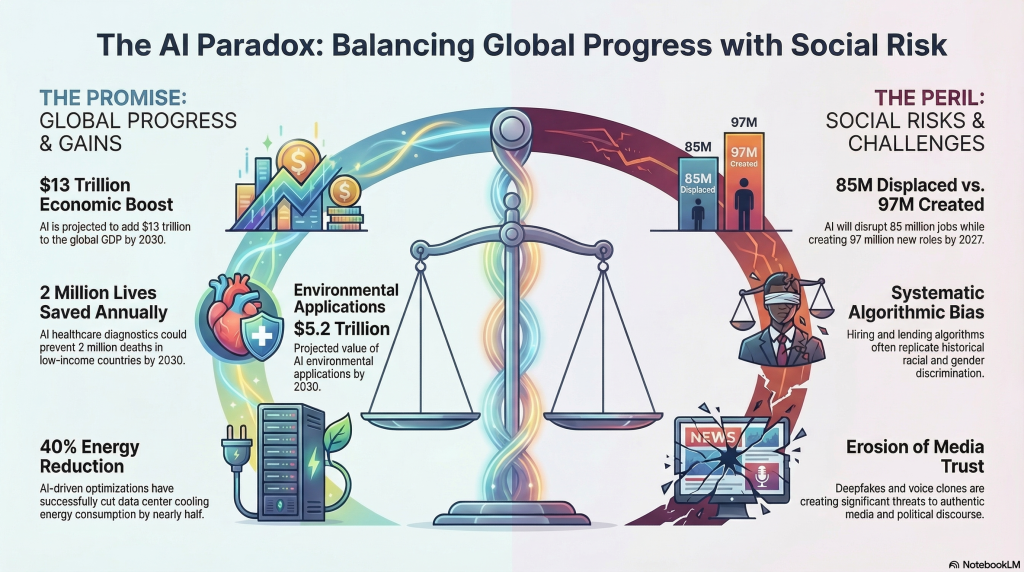
The World Health Organization estimates that AI-assisted healthcare interventions could prevent up to 2 million deaths annually in low- and middle-income countries by 2030.
AI’s Impact on Education
AI is making education more accessible and personalized at a scale that was previously impossible. Adaptive learning platforms like Khan Academy’s Khanmigo use AI to tailor lessons to each student’s pace and learning style, providing instant feedback and identifying knowledge gaps in real time.
The implications for equity are significant:
- Language barriers: AI-powered translation tools allow students to access educational content in their native language, opening up resources that were previously available only in English or other dominant languages.
- Special needs support: AI tools can generate customized learning materials for students with dyslexia, ADHD, and other learning differences.
- Teacher empowerment: Rather than replacing teachers, AI handles administrative tasks — grading, progress tracking, attendance — so educators can focus on mentoring, inspiration, and the human connection that drives real learning.
However, AI in schools also comes with significant pros and cons that educators and parents need to carefully weigh, including data privacy concerns, screen time, and the risk of over-reliance on automated systems.
AI’s Role in Environmental Sustainability
Climate change is arguably the most urgent social challenge of our time, and AI is proving to be a powerful tool in the fight against it:
- Energy optimization: Google used DeepMind AI to reduce the energy used for cooling its data centers by 40%, a model now being adopted by other large-scale energy consumers.
- Precision agriculture: AI-powered drones and sensors help farmers optimize water usage, reduce pesticide application, and increase crop yields — critical for feeding a growing global population sustainably.
- Climate modeling: AI is improving the accuracy of climate models, helping scientists and policymakers make better-informed decisions about mitigation and adaptation strategies.
- Wildlife conservation: Organizations like the World Wildlife Fund use AI to monitor endangered species, detect poaching activity, and track deforestation in real time.
A 2025 report by PwC estimated that AI applications in environmental management could contribute up to $5.2 trillion to the global economy by 2030 while simultaneously reducing greenhouse gas emissions by 4%.
AI Impact on Economy and Job Creation
The AI impact on economy is substantial and growing. According to McKinsey Global Institute, AI could add $13 trillion to global GDP by 2030, representing roughly 1.2% additional GDP growth per year. This economic impact comes through multiple channels:
- Productivity gains: AI automates routine tasks, freeing workers to focus on higher-value activities. Companies implementing AI report productivity improvements of 20-40% in targeted processes.
- New industries and job categories: AI is creating entirely new fields — AI ethics, prompt engineering, machine learning operations, data annotation — that did not exist a decade ago.
- Small business empowerment: AI tools are democratizing capabilities that were once available only to large corporations. A small e-commerce business can now use AI for inventory forecasting, customer service, and personalized marketing at a fraction of the traditional cost.
- Startup ecosystem growth: The AI infrastructure sector alone is projected to be worth over $300 billion by 2028, creating thousands of companies and millions of jobs worldwide.
However, the economic benefits of AI are not evenly distributed, which brings us to the risks.
The Risks and Challenges of AI’s Social Impact
Job Displacement and Economic Inequality
While AI creates new jobs, it also eliminates existing ones — and the transition is not always smooth. The World Economic Forum’s Future of Jobs Report 2025 estimates that AI and automation could displace 85 million jobs globally by 2027, even as they create 97 million new ones.
The concern is not the net number of jobs but the distribution of impact:
- Low-skilled workers bear the brunt of displacement, while high-skilled workers capture most of the gains.
- Geographic concentration: AI-driven economic growth tends to cluster in tech hubs, leaving rural and post-industrial communities further behind.
- The skills gap: Many displaced workers lack the training needed for new AI-era roles, creating a painful transition period that can last years.
As we have explored in our article on whether AI will replace humans, the answer is nuanced. AI is unlikely to fully replace human workers, but it will fundamentally change the nature of work — and societies that fail to invest in reskilling and education will face serious social consequences.
Algorithmic Bias and Discrimination
AI systems learn from historical data, and historical data reflects historical biases. This means AI can perpetuate and even amplify discrimination:
- Hiring algorithms trained on past hiring data have been shown to discriminate against women and minorities, reflecting the biases of human decision-makers whose choices built the training dataset.
- Criminal justice: Risk assessment tools used in sentencing and parole decisions have been found to assign higher risk scores to Black defendants, even when controlling for other factors.
- Financial services: AI-powered lending algorithms have been shown to charge higher interest rates to minority borrowers, echoing patterns of historical redlining.
- Healthcare: An algorithm widely used in U.S. hospitals to allocate healthcare resources was found to systematically deprioritize Black patients because it used healthcare spending — a metric correlated with income, not medical need — as a proxy for health.
These are not theoretical concerns. They are documented cases that affect millions of people’s lives. Addressing algorithmic bias requires diverse development teams, rigorous testing, transparent auditing, and regulatory oversight.
Privacy, Surveillance, and Civil Liberties
AI-powered surveillance is expanding rapidly around the world. Facial recognition systems are deployed in airports, shopping malls, and public spaces. Predictive policing algorithms analyze crime data to anticipate where offenses will occur. Social media monitoring tools track public sentiment and political activity.
The social implications are profound:
- Chilling effect on free expression: When people know they are being watched, they self-censor. Research has shown that awareness of surveillance reduces willingness to express dissenting political views.
- Disproportionate impact on marginalized communities: Surveillance technologies are disproportionately deployed in low-income neighborhoods and communities of color.
- Data exploitation: The collection and monetization of personal data by AI-driven platforms raises fundamental questions about consent, ownership, and digital rights.
The European Union’s AI Act, which took full effect in 2025, represents the most comprehensive attempt so far to regulate AI’s impact on privacy and civil liberties, banning certain uses of AI surveillance and requiring transparency for high-risk systems.
Misinformation and Deepfakes
Generative AI has made it trivially easy to create convincing fake images, videos, and audio. This has serious implications for trust in public institutions, democratic processes, and social cohesion:
- Political manipulation: Deepfake videos of political figures have been used to spread misinformation during elections in multiple countries.
- Fraud and scams: AI-generated voice clones have been used to impersonate executives and authorize fraudulent financial transfers.
- Erosion of trust: When any piece of media could potentially be AI-generated, public trust in authentic evidence and journalism is undermined.
AI for Social Impact: Turning Technology into a Force for Good
The question is not whether AI will have a social impact — it already does. The question is whether we can steer that impact toward positive outcomes. Here are the key strategies for ensuring AI for social impact serves humanity:
Responsible AI Development and Governance
- Ethics by design: Building fairness, transparency, and accountability into AI systems from the start, not as an afterthought.
- Regulatory frameworks: Governments must establish clear rules for high-risk AI applications, following the model of the EU AI Act while adapting to local contexts.
- Diverse development teams: AI systems built by homogeneous teams are more likely to contain blind spots and biases. Diversity in AI development is not just a social goal — it is a technical necessity.
- Public-private partnerships: Collaboration between governments, tech companies, academia, and civil society is essential for developing AI governance frameworks that balance innovation with protection.
Investing in Human Capital
The AI impact on economy will be positive only if workers have the skills to participate in the AI-driven economy. This requires:
- Reskilling and upskilling programs: Governments and employers must invest in training programs that help workers transition to new roles.
- Education reform: School curricula need to emphasize critical thinking, digital literacy, and AI literacy alongside traditional subjects.
- Social safety nets: Robust unemployment insurance, portable benefits, and transition assistance can cushion the impact of AI-driven job displacement.
Social Impact Investing in AI
The convergence of AI and social impact investing represents one of the most promising trends in the field. Impact investors are increasingly directing capital toward AI ventures that generate measurable social and environmental benefits alongside financial returns.
Key areas where impact investing is driving AI for social good include:
- AI-powered climate tech: Startups using AI for carbon capture optimization, renewable energy grid management, and sustainable supply chain monitoring.
- Healthcare AI in underserved markets: Companies developing affordable AI diagnostic tools for low- and middle-income countries.
- EdTech with equity focus: AI education platforms designed specifically for underserved communities and learners with disabilities.
- Financial inclusion: AI-driven microfinance and alternative credit scoring systems that expand access to financial services for the unbanked.
According to the Global Impact Investing Network (GIIN), the impact investing market reached $1.16 trillion in assets under management in 2024, with AI-focused impact investments growing at more than 35% annually.
Community-Centered AI Design
The most effective AI for social good initiatives are those designed with — not just for — the communities they serve. This means:
- Participatory design: Involving community members in the design and testing of AI systems that will affect their lives.
- Local context: Ensuring AI solutions are adapted to local languages, cultural norms, and infrastructure constraints.
- Open source and open data: Making AI tools and datasets accessible to researchers and organizations in developing countries.
The Future of AI’s Social Impact: What to Expect
Looking ahead, several trends will shape the social impact of AI over the next decade:
- Regulation will catch up: More countries will follow the EU’s lead in establishing comprehensive AI regulations, creating a more predictable and accountable landscape for AI deployment.
- AI literacy will become essential: Understanding how AI works — its capabilities and limitations — will become as fundamental as reading and writing. The future of AI depends on an informed public.
- The digital divide will be the defining equity challenge: Countries and communities with access to AI infrastructure and talent will pull further ahead, while those without risk being left behind.
- Human-AI collaboration will become the norm: The most successful organizations will be those that combine AI capabilities with human judgment, creativity, and empathy — not those that pursue full automation.
- AI ethics will move from theory to practice: Ethics boards, impact assessments, and algorithmic audits will become standard requirements for AI deployment in high-stakes domains.
Frequently Asked Questions
What is the social impact of AI?
The social impact of AI refers to the ways artificial intelligence affects communities, economies, and daily life. This includes both positive effects — like improved healthcare, personalized education, and economic growth — and negative ones, such as job displacement, algorithmic bias, and privacy concerns. The net impact depends on how responsibly AI is developed and deployed.
How is AI used for social good?
AI for social good encompasses applications that address pressing social challenges. Examples include AI-powered medical diagnostics in underserved areas, climate change modeling, disaster response optimization, educational tools for learners with disabilities, and financial inclusion platforms for unbanked populations. Organizations like Google.org, Microsoft AI for Good, and the Partnership on AI are actively funding such initiatives.
What is the AI impact on economy?
AI is projected to add $13 trillion to global GDP by 2030, according to McKinsey. It drives economic growth through productivity gains, new industry creation, and innovation acceleration. However, the economic benefits are unevenly distributed, with high-skilled workers and tech-forward regions capturing a disproportionate share of the gains.
What is social impact investing in AI?
Social impact investing in AI involves directing capital toward AI ventures that generate measurable social or environmental benefits alongside financial returns. This includes funding for healthcare AI in developing countries, AI-powered climate tech, and equitable education technology. The impact investing market has surpassed $1 trillion in assets under management globally.
Will AI increase or decrease inequality?
AI has the potential to do both. Without deliberate intervention, AI is likely to increase inequality by concentrating wealth and opportunity among those with access to technology and advanced skills. With proactive policies — including reskilling programs, inclusive AI design, regulatory oversight, and social impact investing — AI can be a powerful force for reducing inequality and expanding opportunity.
How does AI affect healthcare in developing countries?
The social impact of AI in healthcare is especially significant in developing countries, where specialist doctors are scarce and infrastructure is limited. AI-powered mobile diagnostics, telemedicine platforms, and drug discovery tools are improving healthcare access and outcomes. The WHO estimates that AI-assisted interventions could prevent up to 2 million deaths annually in low- and middle-income countries by 2030.
The Enterprise Incubator Foundation (EIF) supports innovation and technology development across Armenia’s ecosystem. Through programs that connect technology with social impact, EIF helps ensure that AI advances benefit communities — not just balance sheets. Because meaningful progress happens when technology serves people.