


What Is Impact Investing? Definition, Types & How It Works
What is impact investing? In simple terms, the impact investing definition refers to investments made with the intention of generating measurable social or environmental benefits alongside a financial return. Unlike traditional investing, which focuses solely on profit, impact investing channels capital toward solutions for the world’s most pressing challenges — from climate change to education access.
Understanding the impact investing meaning has become increasingly important as investors, foundations, and even governments look for ways to align their money with their values. Whether you are a seasoned investor or simply curious about how finance can drive positive change, this guide will help you define impact investing, explore its types, and understand why it matters in 2026 and beyond.
How Does Impact Investing Work?
So, how does impact investing work in practice? The process starts with identifying an investment opportunity that targets a specific social or environmental outcome. Investors then allocate capital — through equity, debt, or other instruments — to organizations, funds, or projects that commit to delivering both financial returns and measurable impact.
Here is a simplified breakdown of the process:
- Set impact goals. The investor defines what social or environmental outcomes they want to achieve (e.g., clean energy access, affordable housing, quality education).
- Source investments. Opportunities are identified through impact-focused funds, social enterprises, community development financial institutions (CDFIs), or direct deals.
- Conduct due diligence. Both financial viability and impact potential are evaluated. This dual assessment distinguishes impact investing from conventional approaches.
- Deploy capital. Money is invested in the chosen vehicles, which may include private equity, venture capital, green bonds, microfinance loans, or real assets.
- Measure and report. Impact metrics are tracked using frameworks like the IRIS+ system from the Global Impact Investing Network (GIIN) or the UN Sustainable Development Goals (SDGs).
Measurement is the critical differentiator. Without rigorous tracking of social and environmental outcomes, an investment cannot truly be called “impact investing.” As a result, transparency and accountability are built into every stage of the process.
Types of Impact Investing
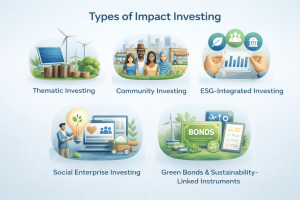
There are several types of impact investing, each suited to different investor profiles, risk appetites, and impact goals. Understanding these categories can help you find the right fit for your portfolio.
1. Thematic Investing
Thematic impact investors focus on specific sectors or issues. Common themes include renewable energy, sustainable agriculture, healthcare access, financial inclusion, and affordable housing. For instance, investing in a solar energy company in an emerging market addresses both climate change and energy poverty.
2. Community Investing
This type directs capital to underserved communities that lack access to traditional financial services. Community development financial institutions (CDFIs) and microfinance organizations are typical vehicles. Furthermore, community investing often targets local economic development and job creation.
3. ESG-Integrated Investing
While not identical to pure impact investing (more on that below), ESG-integrated strategies incorporate environmental, social, and governance factors into investment analysis. This approach is sometimes called ESG impact investing, and it represents one of the fastest-growing segments of responsible investing.
4. Social Enterprise Investing
Social enterprises are businesses designed to solve social problems through market-based approaches. Investing in these organizations — through equity, debt, or revenue-based financing — is a direct way to fund innovation that serves communities. In Armenia and across the South Caucasus, organizations like the Enterprise Incubator Foundation help nurture startups that combine technology innovation with social impact.
5. Green Bonds and Sustainability-Linked Instruments
Green bonds raise capital specifically for environmental projects, such as clean transportation, energy efficiency, or pollution prevention. Similarly, sustainability-linked bonds tie financial terms to the issuer’s achievement of predefined sustainability targets.
Benefits of Impact Investing
The benefits of impact investing extend far beyond feel-good returns. Here is why investors, institutions, and governments are increasingly embracing this approach:
- Dual returns. Impact investments generate both financial returns and measurable social or environmental outcomes. You do not have to sacrifice profit to do good.
- Portfolio diversification. Impact investments span asset classes, geographies, and sectors. This diversity can reduce overall portfolio risk.
- Alignment with values. For individuals and institutions, impact investing offers a way to put money to work in areas they care about — from climate action to education equity.
- Attracting talent and stakeholders. Companies and funds with strong impact mandates often attract mission-driven talent, loyal customers, and engaged stakeholders.
- Addressing systemic challenges. By channeling private capital toward public problems, impact investing helps close funding gaps that governments and philanthropy alone cannot fill.
- Future-proofing investments. Companies that address environmental and social risks proactively tend to be more resilient in the long run. As a result, impact-oriented investments may outperform during market downturns.
In addition, the growing body of evidence shows that impact investing is not a niche strategy. The Global Impact Investing Network estimates the market at over $1.2 trillion in assets under management globally, and it continues to grow rapidly.
Impact Investing vs ESG vs Sustainable vs Socially Responsible Investing
One of the most common points of confusion is the difference between ESG and impact investing, or the difference between sustainability and impact investing. While these terms are often used interchangeably, they represent distinct approaches. Here is how they compare:
Impact Investing vs Sustainable Investing
The key impact investing vs sustainable investing distinction lies in intentionality. Sustainable investing broadly considers environmental and social factors to manage risk and enhance long-term value. Impact investing, however, requires an explicit intention to generate positive, measurable outcomes. In other words, all impact investing is sustainable, but not all sustainable investing qualifies as impact investing.
Impact Investing vs ESG Investing
What is ESG impact investing, and how does it differ from ESG alone? ESG investing uses environmental, social, and governance criteria primarily as a risk management tool. It screens companies based on ESG performance but does not necessarily aim for specific social or environmental outcomes. Impact investing goes further by targeting intentional, measurable positive change.
Impact Investing vs Socially Responsible Investing (SRI)
Impact investing vs socially responsible investing is another important distinction. SRI traditionally relies on negative screening — excluding companies involved in tobacco, weapons, fossil fuels, or other controversial industries. While SRI avoids harm, impact investing actively seeks to create good. Think of it this way: SRI says “do no harm,” while impact investing says “do good.”
Here is a quick comparison table:
| Approach | Primary Method | Goal | Measurement |
|---|---|---|---|
| ESG Investing | Risk screening with ESG factors | Better risk-adjusted returns | ESG scores and ratings |
| SRI | Negative screening (exclusion) | Avoid harmful industries | Exclusion criteria |
| Sustainable Investing | Broad ESG integration | Long-term value with ESG awareness | Various ESG metrics |
| Impact Investing | Intentional capital allocation | Measurable social/environmental impact + returns | IRIS+, SDGs, custom KPIs |
Impact Investing vs Philanthropy
Impact investing vs philanthropy is perhaps the most fundamental comparison. Philanthropy involves donating money without expectation of financial return. The donor gives, and the capital is spent. Impact investing, on the other hand, deploys capital with the expectation of getting it back — ideally with a return.
However, the line between the two is not always clear-cut. Some impact investments accept below-market returns (known as “concessionary” returns) to maximize social impact. These “impact-first” investments sit on a spectrum between pure philanthropy and market-rate impact investing.
Here are the key differences:
- Capital preservation. Philanthropy spends down capital. Impact investing preserves and grows it.
- Scalability. Because impact investments generate returns, the same capital can be reinvested repeatedly. Philanthropic dollars, once granted, are gone.
- Sustainability. Impact investing creates self-sustaining business models. Philanthropy often creates dependency on continued donations.
- Accountability. Both require accountability, but impact investing adds financial discipline to the equation.
Many foundations and family offices now use a blended approach, combining philanthropic grants with impact investments to maximize their total impact. This strategy, sometimes called “catalytic capital,” uses grants to de-risk investments and attract additional private capital.
Is Impact Investing Profitable?
Is impact investing profitable? The short answer is yes — and the data supports it. According to the GIIN’s 2024 annual survey, the majority of impact investors report meeting or exceeding their financial return expectations.
But the longer answer depends on several factors:
- Return expectations vary. Some impact investments target market-rate returns, while others accept below-market returns in exchange for deeper impact. What is the average return for impact investing? Studies suggest that market-rate impact funds have delivered returns comparable to conventional benchmarks, typically in the 5-15% range depending on asset class.
- Risk profile matters. Like any investment, returns depend on sector, geography, stage, and structure. Early-stage social enterprises carry more risk than established green bond issuers.
- Long-term orientation pays off. Impact investments often require patience. However, companies that address environmental and social needs tend to build stronger competitive positions over time.
Is impact investing effective? Beyond profitability, effectiveness is measured by real-world outcomes. The evidence is encouraging: impact investments have funded over 150 million jobs in emerging markets, deployed billions in clean energy, and expanded financial access to hundreds of millions of underserved people worldwide.
Furthermore, the myth that investors must choose between profit and purpose has been thoroughly debunked. A growing body of academic research confirms that integrating impact considerations does not systematically reduce financial returns.
How to Get Into Impact Investing
If you are wondering how to get into impact investing, the good news is that the barrier to entry has never been lower. Here are practical steps for individuals at every level:
For Beginning Investors
- Educate yourself. Start with resources from the Global Impact Investing Network (GIIN) and the UN Principles for Responsible Investment (PRI).
- Start with public markets. Impact-focused mutual funds and ETFs are accessible through most brokerage accounts. Look for funds aligned with the UN SDGs or specific themes like clean energy or gender equity.
- Use robo-advisors. Several platforms now offer impact portfolios that automatically allocate your money to ESG-screened or impact-oriented investments.
- Consider community investment notes. Organizations like Calvert Impact Capital offer notes starting at $20, making impact investing accessible to nearly everyone.
For Experienced Investors and Institutions
- Explore private markets. Impact-focused private equity and venture capital funds offer higher return potential alongside deeper impact engagement.
- Invest directly in social enterprises. If you have the expertise, direct investments in mission-driven companies can yield both financial returns and significant influence over impact outcomes.
- Engage with impact measurement. Adopt frameworks like IRIS+ or the Impact Management Project (IMP) to ensure your investments deliver on their impact promises.
- Join networks. Organizations like Toniic, the Investor Circle, or regional impact investing networks provide deal flow, peer learning, and community support.
For Organizations in Emerging Markets
For technology startups and social enterprises in regions like Armenia and the South Caucasus, impact investing represents a growing source of funding. Organizations like EIF (Enterprise Incubator Foundation) play a crucial role in connecting innovative startups with impact-oriented capital, helping them scale solutions that address local and global challenges.
Why Impact Investing Matters
Why impact investing? The answer is both practical and philosophical. Why is impact investing important? Because the world’s biggest challenges — climate change, inequality, healthcare access, education gaps — require more capital than governments and philanthropy can provide alone.
The United Nations estimates that achieving the Sustainable Development Goals by 2030 requires $5-7 trillion in annual investment. Current public funding covers only a fraction of that amount. Impact investing bridges the gap by mobilizing private capital toward these goals.
In addition, impact investing reshapes how markets operate. When investors demand both returns and impact, companies respond by building more sustainable, inclusive business models. This creates a virtuous cycle where doing good becomes a competitive advantage.
Frequently Asked Questions About Impact Investing
What is social impact investing?
What is social impact investing? It is a subset of impact investing that focuses specifically on social outcomes — such as poverty reduction, education access, healthcare improvement, and community development. While all social impact investing is impact investing, not all impact investing is exclusively social; some targets environmental outcomes like climate mitigation or biodiversity conservation.
Is impact investing the same as ESG?
No. ESG investing uses environmental, social, and governance factors primarily for risk management. Impact investing goes further by requiring intentional, measurable positive outcomes alongside financial returns. ESG is a screening tool; impact investing is an investment strategy with dual objectives.
Can individual investors participate in impact investing?
Absolutely. Individual investors can access impact investing through publicly traded ESG and impact-focused ETFs, mutual funds, community investment notes, and even some crowdfunding platforms. The minimum investment can be as low as $20 with certain providers.
What sectors are most common in impact investing?
The most active sectors include clean energy and climate solutions, financial inclusion and microfinance, affordable housing, sustainable agriculture, healthcare, education, and technology for underserved communities. However, impact investing spans virtually every industry where capital can drive positive change.
The Enterprise Incubator Foundation (EIF) is Armenia’s leading technology and innovation hub, supporting startups, fostering digital transformation, and driving economic development across the South Caucasus. Through initiatives like AI startup programs and technology education, EIF empowers entrepreneurs to build businesses that create lasting social and economic impact.