
When Will AI Replace You? It Will Not. Here Is Why.
“When will AI replace you?” It is a question that fills headlines, fuels anxiety, and dominates conversations at every level of the workforce. From factory floors to boardrooms, from classrooms to creative studios, the fear is real and widespread: machines are coming for our jobs.
But here is the truth that the alarmist headlines consistently miss: AI will never replace humans. Not today, not in ten years, not ever — at least not in the way most people fear. The evidence from research institutions like MIT, Stanford, McKinsey, and the World Economic Forum all points to the same conclusion. The future does not belong to machines alone. It belongs to smart humans who work alongside knowledgeable machines.
This post will explain why through two powerful lenses: the Human-in-the-Loop (HITL) principle and the human superpower of lifelong learning. Together, they form the foundation of a future where people remain not just relevant but irreplaceable.
What AI Actually Does Well — And What It Does Not
Before we argue for human indispensability, let us give credit where it is due. AI is genuinely remarkable at certain tasks.
Where AI excels:
- Pattern recognition at scale: AI can analyze millions of medical images, financial transactions, or customer interactions faster and more consistently than any human team.
- Data processing and prediction: Machine learning models process vast datasets to identify trends, forecast outcomes, and optimize processes with impressive accuracy.
- Automation of repetitive tasks: From sorting emails to assembling products on a factory line, AI handles routine, rules-based work with tireless efficiency.
- Natural language processing: Modern large language models can summarize documents, translate languages, and generate text that is coherent and contextually relevant.
These capabilities are powerful. However, they reveal a fundamental truth about AI: it is knowledgeable, but it is not smart. There is a profound difference.
Where AI falls short:
- No consciousness or self-awareness: AI does not understand what it is doing. It processes tokens, not meaning. A language model does not “know” that the sky is blue — it has learned that the words “sky” and “blue” frequently appear together.
- No genuine empathy: AI can simulate empathetic responses, but it cannot feel. It cannot understand the weight of a cancer diagnosis, the grief of losing a loved one, or the joy of a breakthrough after years of struggle.
- No true creativity: AI generates outputs by recombining patterns from training data. It does not experience inspiration, wrestle with existential questions, or create art born from lived experience. As Stanford’s Institute for Human-Centered AI has noted, AI produces “novel combinations,” not genuine creative leaps.
- No ethical judgment: AI cannot determine right from wrong. It optimizes for objectives defined by humans, which means it can amplify biases, make harmful recommendations, and cause damage when deployed without human oversight.
- Poor performance in novel situations: When AI encounters scenarios outside its training data, it struggles. Humans, by contrast, can reason through entirely new situations by drawing on intuition, analogy, and lived experience.
The bottom line is clear: machines are knowledgeable — they store and process data at extraordinary speed. But people are smart — they understand, interpret, create meaning, and exercise judgment. Knowledge without wisdom, empathy, and creativity is insufficient.
Human-in-the-Loop: Why Humans Are Irreplaceable in AI Systems
The concept of Human-in-the-Loop (HITL) represents one of the most important principles in modern AI deployment. It asserts that the most reliable, ethical, and effective AI systems are those that keep humans actively involved in the decision-making process.
This is not a theoretical idea. It is a proven framework used by the world’s leading organizations.
HITL in Healthcare: Doctors Make the Final Call
AI diagnostic tools like Google’s DeepMind and IBM Watson Health can analyze medical images and patient data to flag potential conditions with remarkable accuracy. A 2024 study published in Nature Medicine found that AI-assisted diagnostic systems detected certain cancers with up to 94% accuracy.
However, the same study found that accuracy improved to 99.5% when AI recommendations were reviewed and validated by experienced physicians. Why? Because doctors bring contextual understanding that AI cannot replicate. They consider the patient’s history, emotional state, family circumstances, and clinical intuition. The AI identifies patterns; the doctor understands the person.
As a result, every major healthcare system in the world maintains the HITL principle: AI assists, but the human clinician decides.
HITL in Autonomous Vehicles: Safety Demands Human Oversight
Despite billions of dollars invested in self-driving technology, fully autonomous vehicles without human oversight remain elusive. Companies like Waymo, Tesla, and Cruise have learned that edge cases — the unpredictable, novel situations that occur on real roads — require human judgment.
A child chasing a ball into the street, an unmarked construction zone, a hand gesture from a police officer — these situations demand the kind of contextual reasoning that AI still cannot match. Consequently, the industry has shifted toward hybrid models where AI handles routine driving while human operators monitor and intervene when needed.
HITL in Content Moderation: Ethics Require Human Judgment
Social media platforms use AI to flag harmful content at scale. However, determining what constitutes hate speech, satire, political commentary, or a genuine threat often requires nuanced cultural and contextual understanding. Meta, for instance, employs over 15,000 human content reviewers working alongside AI systems because the stakes of automated decisions — censoring legitimate speech or failing to remove dangerous content — are simply too high.
HITL in Legal and Financial Decisions
AI is increasingly used in legal research, contract analysis, and fraud detection. Furthermore, AI-powered tools can review thousands of legal documents in hours rather than weeks. But the final judgment on legal strategy, sentencing recommendations, and regulatory compliance decisions remains firmly in human hands. The reason is straightforward: justice requires empathy, context, and moral reasoning — capacities that machines do not possess.
The pattern across all these domains is consistent. According to a 2025 McKinsey Global Institute report, organizations that implement AI with strong HITL frameworks see 30-40% better outcomes compared to those that attempt full automation. The message is clear: the most successful AI implementations are those that augment human decision-making rather than replace it.
Lifelong Learning: The Human Superpower That Machines Cannot Match
If HITL explains why humans must remain in the loop of AI systems, lifelong learning explains why humans will always stay ahead of the curve.
Here is the fundamental difference: when the world changes, machines must be retrained. Their models become outdated, their training data stale, their parameters misaligned with new realities. Retraining an AI model is expensive, time-consuming, and requires massive computational resources.
Humans, by contrast, possess a superpower that no machine can replicate: the ability to learn, unlearn, and relearn continuously and fluidly throughout an entire lifetime.
The World Economic Forum’s Blueprint for the Future
The World Economic Forum’s Future of Jobs Report 2025 provides compelling data on this point. The report found that 59% of the global workforce will need reskilling or upskilling by 2030. But rather than framing this as a crisis, the WEF positions it as an opportunity.
The top skills identified for the future are overwhelmingly human skills:
- Analytical thinking and innovation
- Complex problem-solving
- Critical thinking and analysis
- Creativity, originality, and initiative
- Leadership and social influence
- Emotional intelligence
- Resilience, stress tolerance, and flexibility
Notice that none of these are skills that AI excels at. They are, fundamentally, human capacities that deepen with experience and continuous learning.
The Reskilling Revolution Is Already Underway
Around the world, organizations and governments are investing heavily in programs that help workers adapt to the AI era through continuous learning:
- Singapore’s SkillsFuture initiative provides every citizen with credits for lifelong learning, resulting in over 660,000 participants in 2024 alone.
- AT&T invested $1 billion in reskilling 140,000 employees over five years, preparing them for roles that did not exist when they were hired.
- The European Union’s Pact for Skills has mobilized commitments to upskill and reskill over 10 million adults across the continent.
These initiatives reflect a growing consensus: the workers who will thrive alongside AI are those who never stop learning. People who commit to lifelong learning remain adaptive, creative, and capable of contributions that no machine can replicate.
Why Continuous Learning Gives Humans the Edge
When a human professional learns a new skill, they do not simply add data to a database. They integrate new knowledge with existing experience, create novel connections between disparate fields, and develop deeper intuition over time. A doctor who learns about AI diagnostics does not just operate the tool — they understand its limitations, question its outputs, and improve patient outcomes in ways the tool alone never could.
This capacity for integrative, cross-domain learning is uniquely human. It is the difference between a machine that has been trained on medical literature and a physician who has spent twenty years at the bedside, continuously learning and growing with every patient encounter.
Smart Humans + Knowledgeable Machines = The Real Future
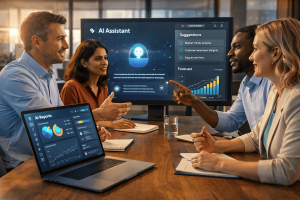
The narrative of “humans versus machines” is fundamentally misleading. The real future is humans AND machines, working together.
Consider the evidence:
- A 2025 study by MIT’s Computer Science and Artificial Intelligence Laboratory (CSAIL) found that human-AI teams outperformed both humans alone and AI alone on complex tasks by an average of 35%.
- McKinsey estimates that AI could add $13 trillion to the global economy by 2030 — but only if organizations invest equally in human capital development alongside technology deployment.
- Research from Harvard Business School shows that companies adopting a “collaborative intelligence” model — where AI handles data-intensive tasks and humans handle strategy, creativity, and relationship management — achieve five times the performance improvements compared to companies that use AI as a simple labor substitute.
The pattern is unmistakable. The greatest returns come not from replacing humans with machines, but from creating partnerships between smart people and powerful AI tools.
In practice, this looks like:
- A radiologist who uses AI to scan thousands of images quickly, then applies clinical expertise to make the diagnosis
- A software engineer who uses AI coding assistants to write boilerplate code faster, then focuses on architecture, design, and solving novel problems
- A teacher who uses AI to personalize learning paths for each student, then provides the mentorship, encouragement, and human connection that drives real learning (as we explored in our recent post on teachers and AI)
- A business leader who uses AI analytics to inform strategy, then exercises the judgment, vision, and empathy needed to lead people through change (learn more about the human side of AI adoption)
In every case, the human is not replaced. The human is empowered.
The Distinction That Matters: Smart vs. Knowledgeable
Let us return to the core distinction that underpins this entire argument.
Machines are knowledgeable. They can store, retrieve, and process information at speeds and scales that humans cannot match. They can identify patterns in datasets of billions of records. They can generate text, images, and code based on statistical patterns learned from vast training corpora.
People are smart. They understand context. They exercise moral judgment. They feel empathy. They create meaning from experience. They adapt to entirely new situations by drawing on intuition, creativity, and wisdom accumulated over a lifetime of learning.
Knowledge is valuable, but wisdom is irreplaceable. A machine can tell you that a patient’s symptoms match a statistical pattern for a particular disease. Only a human doctor can sit with that patient, understand their fears, consider their values, and help them make the decision that is right for their life.
A machine can generate a business plan based on market data. Only a human entrepreneur can feel the pulse of a community, see an opportunity where others see only obstacles, and inspire a team to build something that changes the world.
This is why AI will never replace humans. Not because machines are not powerful — they are. But because power without wisdom, knowledge without empathy, and efficiency without purpose are not enough.
Invest in Yourself. The Future Rewards Those Who Keep Learning.
If you have read this far, you understand the argument: AI will not replace humans who stay curious, keep learning, and remain engaged in the decision-making process. The people at greatest risk are not those whose jobs involve tasks that AI can automate. They are the people who stop learning, stop adapting, and stop growing.
So what should you do?
- Embrace lifelong learning: Whether you are 25 or 55, commit to continuous skill development. Take courses, attend workshops, read widely, and stay curious about new developments in your field.
- Learn to work with AI, not against it: Understanding how AI tools work — their capabilities and their limitations — makes you more valuable, not less.
- Develop your uniquely human skills: Invest in critical thinking, emotional intelligence, creativity, and leadership. These are the skills that will always differentiate you from any machine.
- Stay in the loop: Whether you are a healthcare professional, an educator, an engineer, or a business leader, insist on remaining part of the decision-making process. AI should inform your decisions, not make them for you.
The future will not be defined by AI replacing humans. It will be defined by humans who embrace AI as a tool while continuously developing the wisdom, creativity, and empathy that make us irreplaceable.
People are smart. Machines are knowledgeable. And that distinction will matter more in the years ahead than ever before.
The Enterprise Incubator Foundation (EIF) is committed to empowering innovation and developing human capital across Armenia’s technology ecosystem. Through programs that bridge technology and education, EIF helps individuals and organizations harness the power of AI while investing in the lifelong learning and human skills that drive lasting progress. Because at EIF, we believe the future belongs to smart people working with smart technology.